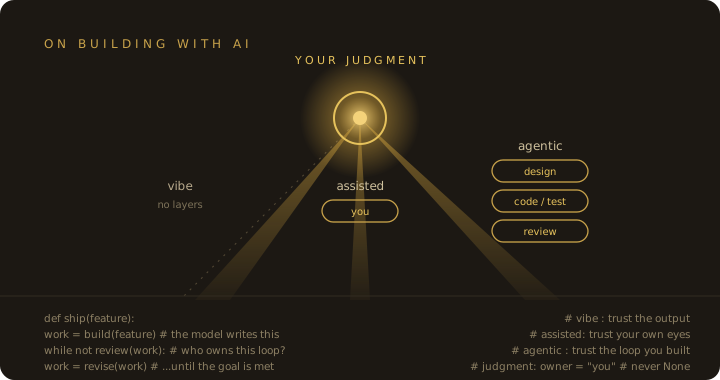
Everyone ranks them like a difficulty setting. Vibe coding for beginners, AI-assisted in the middle, agentic at the top. That ranking hides the only distinction that matters, and it puts the two most different things side by side as if they were neighbors.
Here is the real split. In vibe coding, you trust the output. You ask, the model answers, you ship what comes back. In agentic coding, you trust nothing the model produces on its own. You trust a loop you built to catch its own mistakes and keep going until the work is actually done. One mode bets on a single answer being right. The other assumes every answer is wrong until a process proves otherwise. Those are not two rungs on a ladder. They are opposites.
The thing sitting between them, AI-assisted coding, is the familiar one. The model writes, you read every line. Useful, but it is not where the interesting shift is. The interesting shift is that the moment you stop reading the output, something else has to review it. Either a process does, or nothing does. That is the whole game.
Vibe has no process. Agentic is nothing but process.
Start with what these words actually describe, because the names mislead.
Vibe coding has no process. You ask, the model answers, you take what comes out. There is no design step, no test step, no review step. There is just an output, and you are trusting the output.
Agentic coding is the opposite. It is almost entirely process. You set up a loop, design, then code, then test, then review, and the agents run that loop themselves. When the review fails, the work goes back to coding. When a test breaks, it goes back again. The loop keeps turning until the goal, the actual feature, is met.
There is also a front end to the loop that vibe coding skips. Before any agent writes a line, you spend real time on design: what the system is for, where it fits, what could break, what good looks like. That thinking is not overhead. It is how the assistant builds real context before it starts. Vibe coding skips it and acts on whatever it can infer from a single prompt. Agentic coding does this thinking first, so the agents work from a shared understanding instead of a guess.
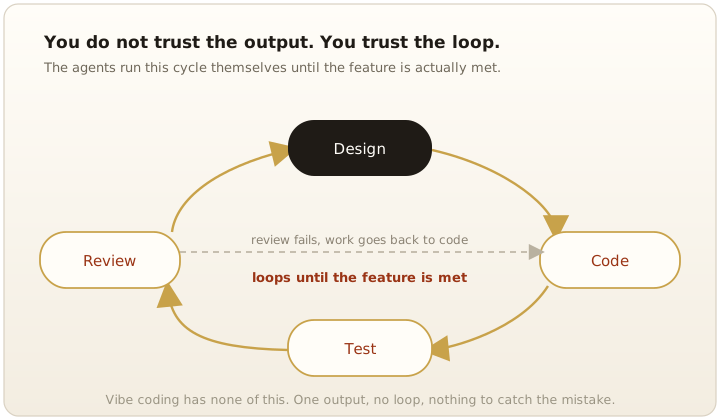
That is the real shift. In vibe coding you trust the output. In agentic coding you do not trust any single output at all. You trust the loop you designed to catch its own mistakes and keep going until it gets there. The output earns trust by surviving the process, not by looking right the first time.
This is why agentic coding can be safe at a scale where reading every line is impossible. The safety does not come from you checking the work. It comes from a process you built that checks the work for you, over and over, until it passes. And it is why vibe coding is risky exactly where it feels easiest. There is no loop. Nothing catches the mistake. The first output is the last word.
The real variable is who reviews the work
Once you see the split as output versus process, the middle mode and the whole spectrum click into place. The thing that changes across all three is not the tool. It is who checks the work before it counts as done.
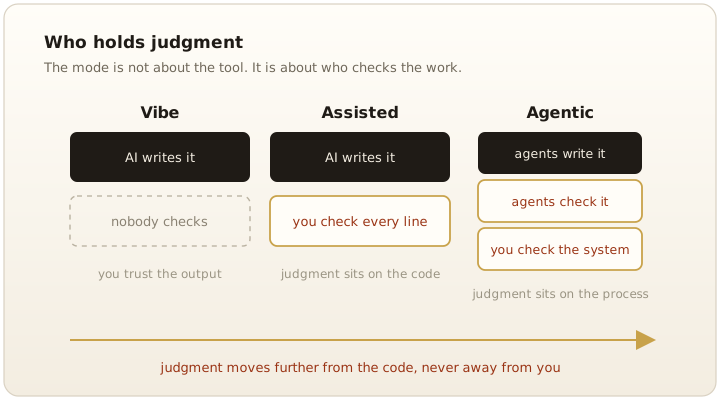
Vibe coding: nobody competent reviews it. You describe what you want, the AI produces something, and it looks like it works. You ship on faith, because you cannot really evaluate it. That is fine when the stakes are low, a quick script, a prototype, a thing only you will ever run. It is dangerous the moment the output matters and you have no way to tell good from broken. Vibe coding is not a skill level. It is a bet that you do not need to check.
AI-assisted coding: you review it. The AI writes the code, often most of it, but you read every line. You hold the standard. You catch the subtle bug, reject the lazy shortcut, redirect when it solves the wrong problem. The AI moves fast, and your judgment sits directly on top of the code, line by line. The work is faster than it used to be, but you never stopped being the reviewer.
Agentic coding: a system you built reviews it. Now there is a team of agents. Some write, some test, some review each other. You are no longer reading every line, because you could not keep up and that is the point. Instead you review the system: the design, the guardrails, the checks that decide what passes. You judge whether the process is sound, not whether each line is. Your judgment moved one level up, off the code and onto the machine that produces it.
This is not new. We have always done this.
If the ladder feels familiar, it should. It is how software has always been built once a team gets big enough.
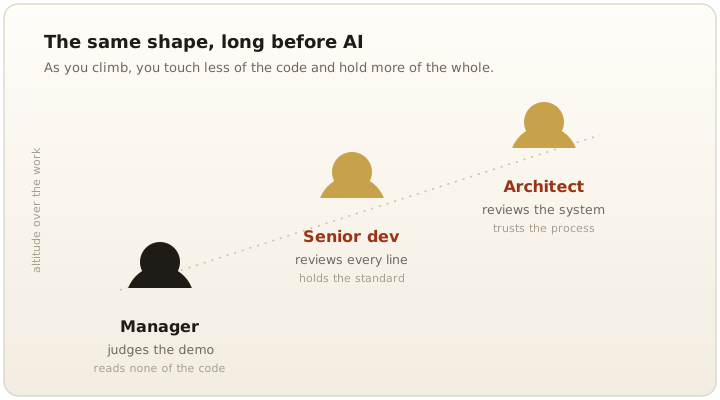
A non-technical manager hands a requirement to a junior developer, cannot judge the code, and judges the demo instead. That is vibe coding. A senior developer reviews everything the team produces and ships nothing they have not read. That is assisted coding. An architect designs the system, lets a full team and a QA group build it, rarely touches the code, and trusts the process to handle the parts. That is agentic coding. The roles are old. The only new thing is that the junior, the senior, and the QA team can now be agents.
Judgment never disappears. It moves.
Here is the thing people miss. As you go from vibe to assisted to agentic, judgment does not leave. It moves further from the code and closer to the design of the process. The architect is not less responsible than the senior developer. They are responsible for more, just at a different altitude.
This is also why vibe coding gets a bad name that it only half deserves. The problem was never the tool. The problem is using it in the one place it does not belong, where the output matters and nobody can judge it. The same AI, in the hands of someone who reviews the work, is assisted coding. The same AI again, wrapped in a system that reviews itself under your supervision, is agentic. The tool barely changed. The location of judgment changed completely.
So the question to ask is not which mode is most advanced. It is simpler and more useful. For this piece of work, who is reviewing it, and are they capable of catching what matters? If the honest answer is nobody, you are trusting a single output, and you had better be sure that is safe. If the answer is you, line by line, you are assisting. If the answer is a loop you built and you are watching the loop, you are working like an architect.
Pick the altitude that matches the stakes. Just never pretend judgment went away. It is always somewhere. Your only real job is to know where.
Comments