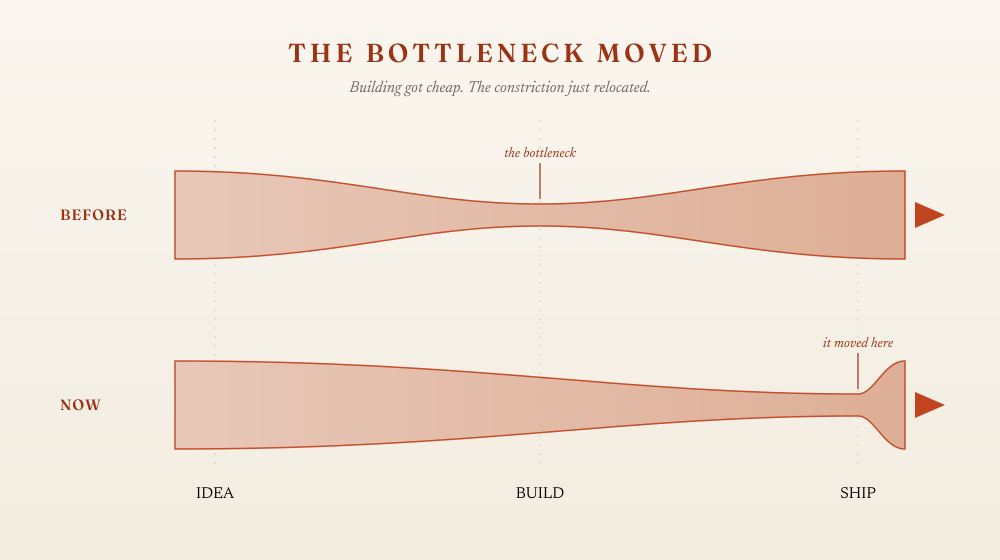
A year ago, a prototype cost a week and a scarce engineer.
Today it costs an afternoon and a prompt.
That single change has quietly rewired how our company works, and not in the way most people assume. The interesting part is not that building got cheap. The interesting part is what got expensive instead.
When experiments were costly, the org learned to say no
Every organization is shaped by what its experiments cost.
When trying something new meant pulling an engineer off the roadmap for two weeks, the rational answer to most ideas was no. Not because the ideas were bad. Because the bet was expensive and the downside was real. So we built approval gates, intake forms, and quarterly planning cycles to ration a scarce resource. We taught the whole company that the default answer to “could we try this” was “file a ticket and wait.”
That default was correct when building was expensive.
It is now a tax on a cost that no longer exists.
The default flip is the real culture change
When an experiment costs almost nothing, the math inverts. The cost of trying drops below the cost of the meeting where you debate whether to try. At that point, the rational default flips from “no” to “try it and show me.”
This is the part people underestimate. The culture change is not the tooling. It is the permission. When anyone in the company can stand up a working prototype in an afternoon, the question stops being “who do I need to convince” and becomes “what did the prototype show.” Arguments get settled with artifacts instead of opinions. And most of the people doing this are not engineers. A marketer tests an idea without borrowing a developer. A finance analyst automates the monthly close. A support lead finally builds the tool they have wanted for two years. They describe what they want to an AI tool, and working software comes back.
That shift in permission is worth more than any individual tool you will deploy. But it only works if you can say yes safely. And that is where most companies are about to get hurt.
Cheap to build is not the same as safe to ship
Here is the trap. The same drop in cost that lets your best people experiment also lets anyone deploy almost anything. A prototype that touches customer data, calls a paid model in a loop, or quietly becomes load-bearing for a real workflow is no longer a harmless afternoon project. It is a liability that nobody reviewed.
So the scarcity moved. It used to be engineering capacity. Now it is safe surface area to deploy on.
If you flip the default to “try it” without solving this, you do not get an innovation engine. You get sprawl. Ungoverned tools, untracked spend, data leaving through doors nobody is watching, and shadow systems that become critical before anyone admits they exist. That is not a culture of experimentation. It is a cleanup bill with a delay on it.
The job, then, is not to enable building. Building is already free. The job is to make failure cheap, contained, and reversible.
The platform’s real job is making failure safe
This is what a self-service platform is actually for. Not convenience. Containment.
The way we think about it: a person should be able to take an idea to a running, shareable prototype without talking to anyone, and the platform should guarantee that the worst case is bounded no matter what they build.
In practice that means a few things working together. Prototypes run in an isolated space by default, so a bad experiment cannot reach production or real customer data. Spend is capped at the platform layer, so a runaway process hits a ceiling instead of a surprise invoice. Every model call goes through one common path where logging, policy, and safety checks apply automatically, so the builder never has to remember them. Permissions start tight and widen only as a project earns them. And turning an experiment into something real is a deliberate, reviewed step, never an accident of a prototype quietly picking up traffic.
The principle underneath all of it: the platform makes the safe path the easy path. If doing the right thing requires discipline, people will skip it. If the only path the platform offers is already safe, you get speed and safety at the same time, instead of trading one for the other.
Guardrails framed this way are not a gate. They are the reason you can take the brakes off everywhere else.
Most of your builders will not be engineers
It is tempting to picture this platform as a faster tool for the engineering team. That is the smaller half of the story.
The larger half is everyone else. The finance analyst, the recruiter, the operations lead, the marketer, all of whom can now describe a workflow to an AI tool and get working software back. The work that never justified an engineering ticket is suddenly automatable by the person who actually feels the pain. That is the real prize. It is also where the risk changes shape completely.
A non-technical builder cannot be expected to know about secrets, data exposure, injection, or least privilege. And the code did not come from them. It came from an AI tool, which means even the person deploying it often cannot fully read what they are shipping.
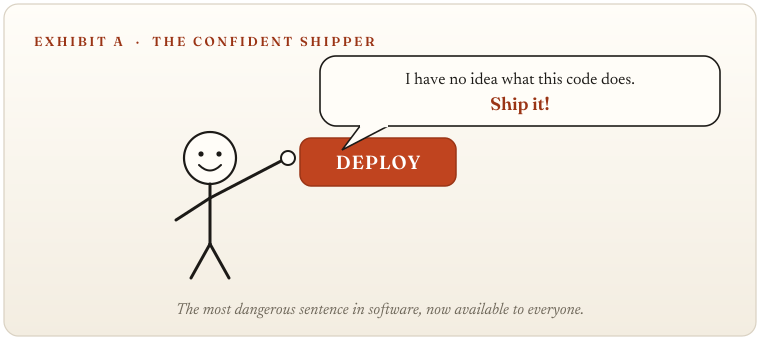
So security cannot sit with the builder anymore. They do not have the knowledge, and they did not write the code. In the old world, security was a skill the builder was expected to have. In an AI-native company, security has to be a property the platform provides. The less the builder knows about safety, the more the platform has to carry on their behalf. The right assumption is that the builder cannot vouch for what they are shipping, and the platform should contain it on exactly that assumption. That is not a constraint on this audience. It is the only thing that makes this audience safe to set loose.
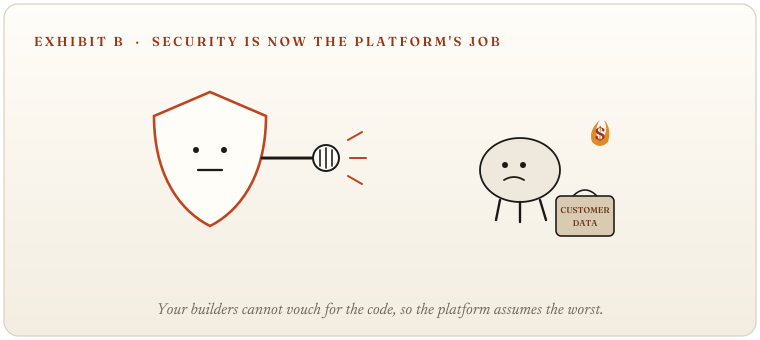
Deployment has to be effortless in the same breath. If going from a working prototype in an AI tool to a safely running internal app is a single step, people take the safe path. If it takes a setup guide and a list of prerequisites, they will paste the code somewhere unsafe instead, and you will not find out until it breaks. Easy and safe are not in tension. Easy is what makes the safe path the one people actually use.
Cheap experiments do not compound on their own
There is one more piece, and it is the one that turns activity into advantage.
A thousand prototypes that nobody learns from is just a thousand units of cost. Speed without memory is motion, not progress. The experiments only compound if the organization captures what each one taught: what was tried, what worked, what failed, and why. Otherwise you will watch three different teams independently discover the same dead end, which is exactly the waste an AI-native company is supposed to eliminate.
This is the through-line from everything else we are building. Experiments feed the organization’s memory. The memory makes the next experiment smarter. The platform is not just a place to deploy. It is the top of a learning loop.
Productivity is shots on goal, not output per head
It is tempting to measure this in output per person. That is the wrong frame.
The real lever is shots on goal. Most experiments will not work. That is fine, and it is the point. The value is in the rare outsized win, and you cannot predict which experiment produces it. So the organization that can safely run ten times the experiments is not ten percent better. It is sampling from the same distribution ten times as often, which means it finds the breakthroughs the cautious organization never reaches.
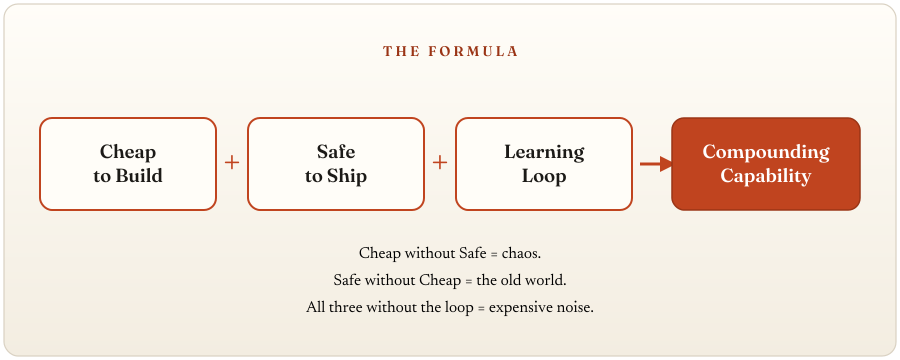
Cheap plus safe plus a learning loop is what converts raw experiment volume into compounding capability. Remove any one of the three and it falls apart. Cheap without safe is chaos. Safe without cheap is the old world. Both without a learning loop is expensive noise.
The platform is the governor
So the self-service platform is not a convenience layer bolted on for morale. It is the governor that decides whether cheap experimentation compounds into organizational intelligence or collapses into a mess someone has to clean up next quarter.
Building got cheap for everyone at the same time. That is not an advantage. It is table stakes. The advantage goes to whoever can let their entire company experiment freely without the downside, and then actually learn from what comes back.
Build that, and you will out-experiment your competitors. Out-experiment them for long enough, and you will outlearn them. And outlearning everyone else was the whole game to begin with.
Written from the field while building an AI-native company. If it resonated, the best compliment is to argue with it.
Comments