Most companies think AI is about productivity.
It is not.
AI is about organizational learning.
The companies that define the next decade will not necessarily have the largest teams or the deepest funding. They will be the ones that learn faster than everyone else.
Traditional companies are not built to learn fast
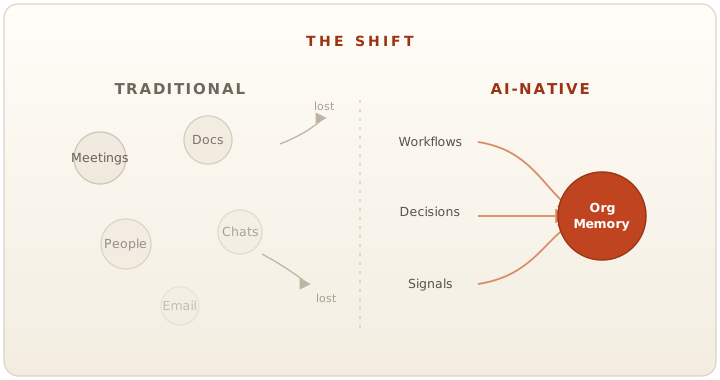
Knowledge is scattered across meetings, documents, departments, and individual minds. Insights surface and then quietly disappear. Teams repeat the same mistakes because institutional memory is weak, fragmented, and mostly undocumented.
In most organizations, the knowledge that matters is trapped inside people rather than systems.
When a person leaves, the knowledge leaves with them.
AI changes this completely.
Every workflow can become structured. Every decision can become searchable. Every experiment can become reusable. Every customer interaction can sharpen the next one.
AI-native companies convert operational activity into organizational intelligence. That is the real shift.
The advantage is not automation. It is compounding.
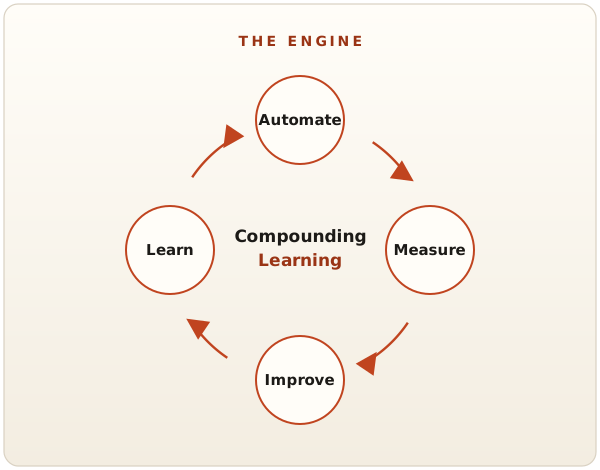
When a workflow is automated, it also becomes measurable. When it becomes measurable, it can be improved. Improve it enough times and the organization develops faster feedback loops, sturdier systems, and a stronger operational memory.
This produces a compounding effect that traditional organizations struggle to match.
Small teams become dramatically more capable, not because they work harder, but because they spend less time coordinating and more time executing. AI strips out organizational friction. Decisions move faster. Knowledge spreads faster. Experiments run continuously.
The result is not simply higher productivity.
It is higher learning velocity.
Most companies will adopt AI without becoming AI-native
They will bolt AI tools onto slow processes and rigid hierarchies, leaving the shape of the organization untouched. They will use AI without ever rethinking how the company itself works.
AI-native companies think differently. They treat workflows as software, knowledge as infrastructure, and AI as part of the operating system of the company.
The long term advantage will not come from access to models. Models will become abundant and widely available.
The real moat is organizational intelligence.
Companies that learn faster build better systems. Better systems produce better execution. Better execution generates more data and more learning.
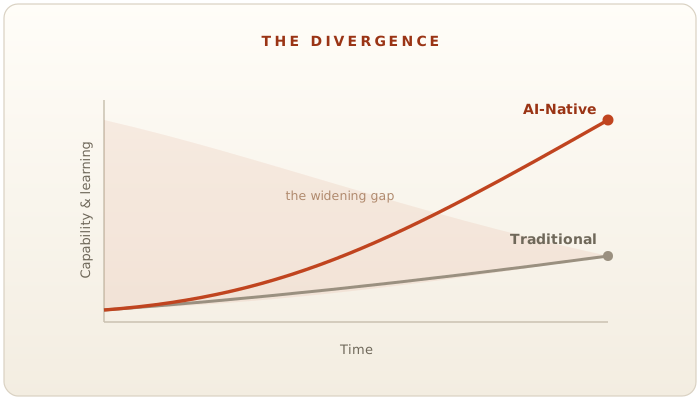
This loop compounds. And compounding curves do not stay close for long.
The next generation will operate as learning systems
They will not simply use AI. They will run as systems that get smarter with every workflow, every decision, every interaction.
And in time, they will outpace every organization that cannot adapt at the same speed.
Written from the field while building an AI-native company. If it resonated, the best compliment is to argue with it.
Comments